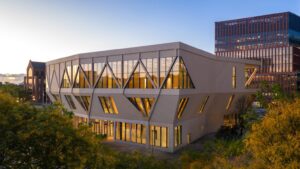
 The Treehouse at Harvard University (designed by Studio Gang) uses exposed mass timber to create a “climb-into-the-treetops” gathering space. Why wood? Because it offers warmth, structure, and sustainability — and shows how material choice matters.

About the Project
-
The “Treehouse” is a new 55,000 sf (approx.) conference and event facility at Harvard’s Enterprise Research Campus in Allston, Boston.
-
It is designed by Studio Gang and is Harvard’s first large building using mass timber as a major structural and aesthetic component.
-
The building is aimed to be a welcoming, flexible hub: multiple entrances, transparent facades, indoor-outdoor connections (covered porches/loggias) and spaces for gatherings, meetings and events.
-
Sustainability is built-in: all-electric systems, solar photovoltaics, rainwater harvesting, bioswales, and a low-carbon structure including mass timber and low-embodied-carbon concrete.
 Why mass timber?
Wood, specifically mass timber (e.g., cross-laminated timber (CLT), glulam beams), was chosen for several reasons relevant to both design and environment. Key reasons:
Lower embodied carbon: Timber stores carbon; using sustainably-harvested wood reduces the carbon footprint compared to conventional materials (e.g., steel or traditional concrete).
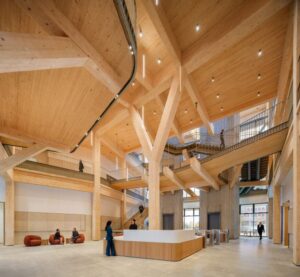
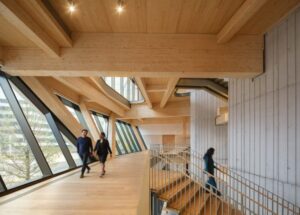
Aesthetic warmth and natural feel: The architects intentionally made the structure visible—wood columns, beams, exposed timber structure—so that users “feel” they are in a timber building.
Connection to nature / treehouse metaphor: The branching timber columns and structural geometry evoke the idea of climbing into a treehouse; the design ties to trees and canopy both physically (views of treetops) and metaphorically.
Performance benefits: Mass timber can offer structural strength, speed of construction (prefabrication of panels), and can pair well with other sustainability systems. Also, the visual pattern of V-shaped columns and branching supports allowed for large open spans (for gatherings) while expressing the timber structure.
Visibility as sustainability statement: By making the timber structure visible and celebrated, the building communicates a “better way of building” model.
 How DIY-ers might apply this thinking small-scale projects
While your budget and scope are clearly different (small DIY versus 55,000 sf conference center!), there are takeaways you can adapt:
Use wood with intention, not just function: Suppose you’re building a garden shed, a pergola, or interior shelving. Choose a wood species or reclaimed timber, then expose the structure (beams, joints) rather than hiding it behind drywall or paneling. It gives warmth, character, and speaks to craftsmanship.
Highlight joints or “branching” connections: The Treehouse uses V-shaped columns and visible diagonals. For a smaller project, you might substitute with angled braces, exposed joinery (e.g., mortise-and-tenon, steel strap accents) to hint at structure rather than hiding everything.
Consider sustainability and material sourcing: Even small projects benefit by choosing responsibly sourced wood (FSC, local species), salvaged timber, or using off-cuts creatively. That adds story and value.
Let the structure influence the experience: In the Treehouse, climbing the stair, looking out through timber frames, stepping onto a terrace—all emphasize experience. For you: design your project so users notice the material and form. For example, a floating timber shelf beneath a window that references the landscape; or a timber canopy over a patio that gives “outdoor room” feel.
Combine wood with light, views, openness: The building uses skylights and a central staircase to let daylight into the timber structure. In DIY: use glass, skylights (or roof lanterns), or open grid ceilings so timber surfaces catch light and become part of the ambience.
Visibility and simplicity: Use simple, honest detailing. You don’t need flashy joinery; the idea is letting the wood be ‘honest’. In your project: perhaps leave surfaces un-painted or use a clear finish, show the end grain, highlight the natural texture.
Scale appropriately: You won’t build a massive timber hall, but you can scale the idea: for instance, choose heavier timber elements (say, 4×4, glulam beams) even in a small structure to get that robust, tactile feel.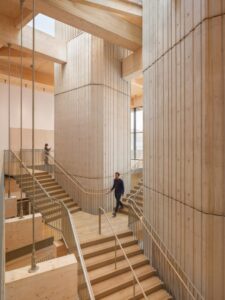
Use structure as design: Instead of hiding the framing, treat the framing as part of the aesthetic. In your plan, think “what if the beams, braces, posts are visible and part of the look?”
Connect to site / context: The Treehouse engages with its campus’ green space and treetops. For you: orient your timber structure to embrace your garden, trees, view; perhaps align beams with tree canopy lines, or integrate outdoor/indoor transitions.
All photography is by Jason O’Rear.
Project credits:
Owner/operator: Harvard University
Fee developer: Tishman Speyer
Design architect and architect of record: Studio Gang
Landscape architect: SCAPE
Structural engineer: Arup
Sustainability consultants: Perkins&Will, Harvard Office for Sustainability, and Arup
MEP/FP engineer: Arup
Civil engineer: Nitsch Engineering
Geotechnical engineer: Haley & Aldrich
Accessibility/code: Code Red Consultants
Envelope: Front
Waterproofing: Simpson Gumpertz & Heger
Lighting: Tillotson Design Associates, George Sexton Associates
Acoustics, audio visual, information & communications technology: Arup
Identity, signage, wayfinding: Once–Future Office
Vertical transportation: Edgett Williams Consulting Group
Food service: Ricca Design Studios
Logistics & waste management: Kleinfelder
Facade access: Lerch Bates
Cost estimator: Vermeulens
Contractor: Consigli and Smoot Construction
Source: https://www.dezeen.com/2025/10/29/studio-gang-rubenstein-treehouse-harvard/