A mid-size Czech city just built multi-story rental housing out of timber, on a budget, on schedule, for the first time in the country’s history. The Northeast U.S. has been sitting on the resource base to do the same thing for decades. Nobody’s built it yet.
The model.
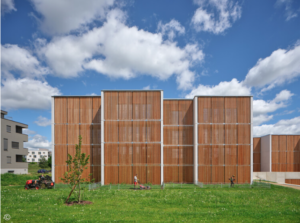
Žďár Wooden Housing, designed by Kuba & Pilař architekti (lead architects Ladislav Kuba and Tomáš Pilař, with Radka Vašut and Ivona Uherková) for the city of Žďár nad Sázavou, works less as a template to copy detail-for-detail than as a proof of concept for what regional timber, used at scale, can do for housing a region actually needs.
Two buildings, four stories each, organized around a traditional city-block layout — public street edge, shared courtyard, private front gardens. Structurally it’s a hybrid: CLT panels for walls and floor slabs, glulam trusses in the gallery structures, reinforced concrete held in reserve for elevator and stair cores and select exterior elements. Everything was prefabricated and assembled on site. The timber structure came from a regional supplier (Nema), the shutters from another (VOÏVO) — a supply chain built around what’s available close by, not shipped in.
The project matters less for its detailing than for its client list: it was developed jointly by the city of Žďár nad Sázavou and a regional bank, with support from the national Ministry of Regional Development, specifically as affordable rental housing. The driver was a housing-supply problem, and timber construction happened to solve it well — not a design-forward vanity project looking for a rationale.
The transferable part
Strip out the Czech-specific details and what’s left is a formula the Northeast can actually run:
- A regional softwood resource capable of structural and appearance-grade output — EWP and SPFs cover both, with design values and grading infrastructure already in place through ALSC-accredited agencies.
- A prefabrication-friendly structural system — CLT and glulam aren’t exclusive to European spruce; northeastern mills and engineered-wood producers are already positioned to supply comparable systems in EWP or SPFs.
- A genuine affordability mandate, not an aesthetic one. Žďár’s timber choice was driven by a housing shortage and a cost target, with public and financial-sector backing to match. The Northeast has the same shortage. It doesn’t yet have the equivalent public-private commitment to try wood as the answer.
What’s actually missing
The trees are there. The mills are there. What the Northeast hasn’t assembled is a first mover willing to treat multi-story timber housing as infrastructure policy rather than architectural experimentation — the kind of political and procurement will that’s exactly what’s at stake in New Hampshire’s SB 529 and similar wood-use procurement pushes elsewhere in the region. Žďár had a city government, a bank, and a ministry willing to back an unproven-at-home building type because the housing math worked.
The case
Regional timber, prefabricated hybrid structure, public-sector backing, affordable rental as the actual goal — is exportable, and the Northeast has more of the raw material to run it than the country that just did. Admiring the design from a distance is the least useful response available.
Photography by BoysPlayNice.
Source: “Zdar Wooden Housing / Kuba & Pilař architekti,” ArchDaily, published July 10, 2026. Photography by BoysPlayNice. https://www.archdaily.com/1054030/zdar-wooden-housing-kuba-and-pilar-architekti