What Your Grade Stamp Is Actually Telling You.
Part 1 of 3: How Lumber Gets Graded
This is the first in a three-part series from NELMA breaking down what’s in a lumber grade stamp and why it matters. Part 2 covers species designations. Part 3 covers the certification and traceability system.
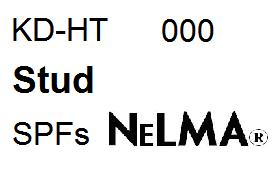
Every piece of dimensional lumber that leaves a certified mill carries a grade stamp. Most people on the job site treat it as background noise — a smudge of ink that means the wood passed some inspection somewhere. That’s underselling it considerably.
The grade stamp is a compressed regulatory document. It tells you what the lumber is rated to do structurally, what species you’re working with, where it came from, and who verified it. Building officials require it. Engineers rely on it. And if there’s ever a question about whether the right material was used, it’s your chain of custody.
This first installment focuses on the part of the stamp most directly tied to structural performance: the grade itself.
Grading Dimension Lumber Is a Structural Determination, Not an Aesthetic One
When a grader evaluates a piece of lumber, they’re assessing characteristics that predict how that piece will perform under load — how much it can bend before failure, how reliably it will transfer stress across a span, how consistent its properties are likely to be. The visual characteristics that drive grade determination include:
- Knot size and location — knots reduce the effective cross-section of a board and interrupt grain continuity. A large knot at the edge of a joist in a tension zone is more structurally significant than the same knot near the center. Grading rules specify allowable knot sizes by location.
- Slope of grain — when wood fiber runs at an angle to the board’s length, the board is weaker than one with straight grain. Grading rules set maximum allowable slope.
- Checks and splits — separations along the grain affect shear capacity.
- Wane — the presence of bark or missing wood at the edge of a board reduces the usable cross-section.
- Shake — separation between growth rings, which can affect shear strength in beams and joists.
A board with visible knots is not automatically a low-grade board. The relevant question is whether those knots fall within the tolerances specified for that grade — and those tolerances are calibrated against the structural demands of the applications that grade serves.
The Structural Grades: What Each One Means
For structural light framing and dimension lumber — the material used in walls, floors, and roofs — visual grades run from highest to lowest as follows:
Select Structural is the top visual grade. It permits the fewest and smallest defects and carries the highest published design values for bending strength (Fb), tension, compression, and stiffness (E). It’s specified when design loads require the full capacity of the species, or when spans push toward the limits of what No. 1 can support.
No. 1 allows somewhat larger defects than Select Structural but still carries strong design values. In practice, No. 1 and Select Structural are often bundled together at the yard as “No. 1 & Better,” since demand for the distinction between them is limited in most residential applications.
No. 2 is the workhorse grade of the residential construction industry. It accounts for the majority of framing lumber sold and used in the U.S. Building codes typically cite No. 2 as the minimum acceptable grade for structural framing, and span tables in the IRC are based on No. 2 design values. For most applications — 2×10 floor joists, 2×6 wall studs, standard roof rafters — No. 2 is exactly what the engineer of record assumed when they ran their calculations.
No. 3 allows the most significant defects of any structural grade. It carries notably lower design values and is generally not appropriate for primary structural members. It appears in applications where load demands are minimal and code requirements specifically permit it.
Stud grade is a parallel designation for vertical load-bearing applications. Stud-grade lumber is evaluated specifically for use in walls, where the primary load is compression along the length of the board. It is not interchangeable with No. 2 for horizontal applications like joists or rafters.
Design Values: The Numbers Behind the Grade
Each grade designation corresponds to a set of published design values — actual engineering numbers used in structural calculations. These values are species-specific (more on that in Part 2), but the grade determines which set of values within a species applies.
The key design values are:
- Fb (Bending Strength) — the primary value for joists, rafters, and beams; represents the stress the piece can sustain in bending before failure
- Ft (Tension parallel to grain) — relevant for bottom chord members in trusses and similar applications
- Fc (Compression parallel to grain) — used for columns and studs
- Fc⊥ (Compression perpendicular to grain) — relevant at bearing points, like where a joist rests on a sill plate
- Fv (Shear strength) — governs in short, heavily loaded spans
- E and Emin (Modulus of Elasticity) — governs deflection calculations; important for floor systems where stiffness, not strength, often controls
These values are published in the National Design Specification for Wood Construction (NDS) Supplement and are the basis for every span table, every truss design, and every wood structural calculation an engineer produces. The grade stamp on the lumber is what connects the actual material in the field to the values used on paper.
Using lower-grade material than specified doesn’t just violate code — it means the published design values no longer apply, and the structural assumptions the engineer made are no longer valid.
Machine-Graded Lumber: An Alternative to Visual Grading
Not all structural lumber is graded by eye. Machine Stress Rated (MSR) and Machine Evaluated Lumber (MEL) are graded by equipment that nondestructively tests each board’s stiffness — typically by measuring deflection under a known load — and assigns grade accordingly.
MSR grades are designated differently than visual grades. Instead of No. 1 or No. 2, you’ll see designations like 1650f-1.5E or 2100f-1.8E — the first number is the allowable bending stress (Fb) in psi, the second is the modulus of elasticity in millions of psi. These designations allow engineers to specify precise performance levels, which is why MSR and MEL lumber dominates engineered applications like I-joist flanges, truss chords, and laminated veneer lumber (LVL) components.
MSR lumber still carries a grade stamp, but it looks different from a visual grade stamp — look for the f-E designation rather than a grade number.
The Practical Takeaway
When you pick up a piece of lumber and read “No. 2” on the stamp, that’s not a default or a fallback — it’s a specific structural designation with defined engineering properties that a grader certified, an agency supervised, and a mill produced to meet. It’s the grade most structural framing is designed around.
If the drawings say No. 2, use No. 2. If they say Select Structural, the engineer had a reason. And if the stamp is missing or illegible, that’s a conversation to have before the framing inspection — not after.