
In Freeport, Maine, students and researchers now gather in a building that was designed to do more than shelter them — it was designed to teach them something just by existing.
The Smith Center for Education and Research at Wolfe’s Neck Center for Agriculture and the Environment opened last fall as the campus centerpiece of a 600-acre working farm focused on regenerative agriculture. Designed by Belfast-based architecture studio OPAL, the 8,800-square-foot building is mass timber throughout, modeled after the working barns on the property, and built to Passive House standards. It is entirely fossil-fuel free and is expected to produce more energy than it consumes over its lifetime.
It is also, simply, a beautiful wood building — and that matters more than people often realize.
A growing body of research connects exposure to wood and natural materials in learning environments with measurable improvements in student outcomes. A 2024 study examining biophilic design interventions in two schools found that students in classrooms enriched with natural elements showed academic test score gains more than three times higher than the prior year’s cohort in the same room, with the same teacher and curriculum. The same research documented reduced stress, better behavior, higher teacher retention, and lower absenteeism. A separate Japanese study comparing wood school buildings to reinforced concrete found that both teachers and students reported less fatigue in wood environments.
The term researchers use is biophilic design — the idea that humans have an inherent inclination toward nature, and that our built environments can either satisfy or frustrate that need. In practice, wood is one of the most direct and accessible expressions of that connection. It is tactile, warm, and recognizable to people in ways that glass and steel are not.
For NELMA members, this is not abstract. The mills and manufacturers across the Northeast supply the material that makes these kinds of buildings possible. When an architect in Belfast designs a mass timber education center and a contractor in Freeport builds it, the wood that went into those walls and beams came from somewhere — from the forests and mills that NELMA represents.
Maine is producing a generation of wood buildings in education and research settings that are being noticed nationally and internationally. That recognition is worth something — not just as a point of pride, but as a signal about where the market is heading and what it expects from the material.
The case for wood in schools is no longer a design preference. It is a documented argument about student health, learning outcomes, and the kind of environments we choose to build for the people we most want to invest in. When Maine architects and builders make that choice, the forests and mills of the Northeast are part of what makes it possible.
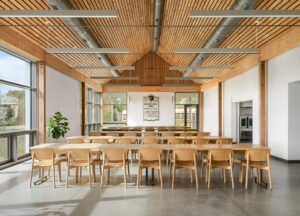
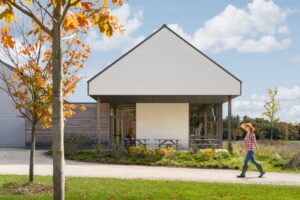
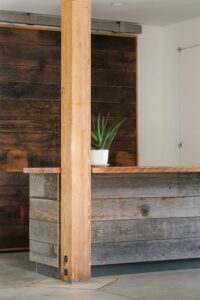

The photography is by Trent Bell.
Project credits:
Architecture: OPAL
OPAL design team: Timothy Lock, Gabe Tomasulo, Dan Rodefeld,
Interior & graphic design: Molly Quesada
Contractor: Zachau Construction
Civil engineer: Thomas Fowler
Structural engineer: Thornton Tomasetti
Mechanical, electrical & plumbing engineer: Taitem
Landscape: Michael Boucher Landscape Architecture
FMI:
www.dezeen.com/2026/05/25/smith-center-education-research-opal-maine/
www.opalarch.us/about-us