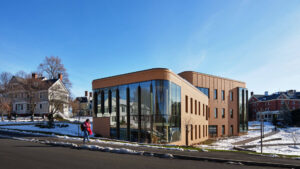
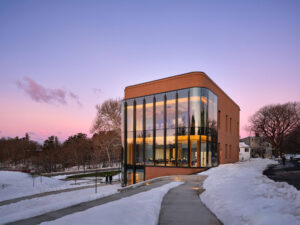
Last fall, Smith College opened Kathleen McCartney Hall — a 15,000-square-foot mass timber hub on its Frederick Law Olmsted–designed campus in Northampton, Massachusetts. Designed by TenBerke with structural engineering by Thornton Tomasetti, the building houses the college’s career development and leadership programs. It’s all-electric, net-zero ready, targeting LEED Gold, and tied into the campus geothermal system.
It is also modeling Smith students something valuable for our industry: Wood is a structural material. It belongs in serious buildings.
That’s not a small lesson. For decades, the default assumption in professional education — and in professional practice — has been that concrete and steel are the rigorous choices and wood is the rustic one. Mass timber has been quietly dismantling that assumption, project by project. But assumptions embedded in early career formation are stubborn. Students become the architects and engineers who write the specs. The specs become the buildings. The buildings become the defaults of the next generation.
This is why projects like Kathleen McCartney Hall matter beyond their own four walls: they normalize wood as a material for ambitious, high-performance design. When students meet with career advisors under exposed mass timber framing, sustainability isn’t an abstraction. It has a grain pattern.
 It’s also why a bill moving through the New Hampshire Legislature deserves more attention than it’s gotten.
Senate Bill 529, which received a final enrolled amendment earlier this month, requires state-funded building projects to give preference to US-sourced lumber and to reference SPFs — the American spruce-pine-fir species designation — in construction drawings and design specifications. It’s a preference measure, not a mandate. But it does something consequential: it puts northeastern wood on the specification sheet.
That matters because specifications are where the next generation of builders and designers learns what materials are considered. If American SPFs lumber never appears in the drawings they study or the public buildings around them, it won’t appear in their professional instincts either — regardless of how the material actually performs.
The gap between SPFs and its Canadian counterpart SPF is a grading artifact, not a performance reality. SB 529 is a modest policy correction to a decades-old market distortion. But it’s also, quietly, a vote for a built environment designed with the forest in mind.
Buildings like Kathleen McCartney Hall make that argument in wood and light and structure. Legislation like SB 529 makes it in statute. Both matter.