Every building material makes an argument about where it comes from. Concrete says it came from industry. Steel says it came from somewhere far away and very hot. Wood says it came from here.
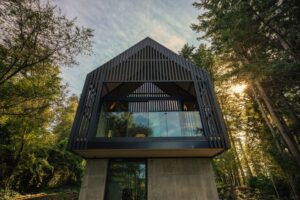
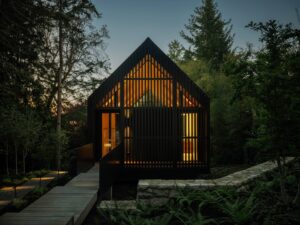
When Calgary-based Little Giant described their Forest Studio on Vancouver Island as drawing on the “spirit of a treehouse,” they weren’t reaching for a charming metaphor. They were identifying something structurally true: wood is the only building material with a living precedent in the landscape it occupies. The darkened cedar screen wrapping Forest Studio doesn’t blend with the surrounding Douglas firs by coincidence or clever finish selection. It belongs there because it is there — a variation on the same material the forest has been producing for centuries.
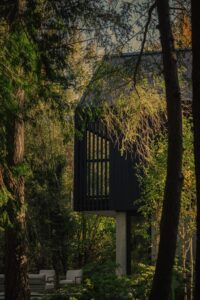
That’s what the treehouse spirit actually means. Not nostalgia. Not rusticity. The treehouse works — aesthetically, emotionally, spatially — because it uses the forest’s own vocabulary to make something human-scaled within it. Little Giant’s Forest Studio does exactly that at a professional level: a recessed concrete base holds the building to the earth while darkened cedar lifts it into the canopy, and after dark the screen glows like a lantern from within. The building reads as found and made simultaneously.
No other structural material achieves this. Concrete and steel are imports. They can be beautiful, even contextually sensitive, but they cannot belong to a wooded hillside the way wood can. They have no living counterpart standing fifty feet away.
Northeastern softwood lumber grows in landscapes with their own character and their own vernacular. The question Forest Studio puts to designers working anywhere near a treeline is a simple one: what would it mean to build in the spirit of what’s already there?
Source Article: https://www.dezeen.com/2026/05/26/little-giant-forest-studio-vancouver-island-british-columbia/
Photography is by Chris Amat.
Project credits:
Architecture and interior design: Little Giant
Contractor: Maximillian Huxley