

Completed in 2024 by the French practice AT Architecture, The Very Small Housing Collective a subtle yet powerful reinterpretation of suburban housing that responds to contemporary social and environmental challenges. Located in Carry-le-Rouet on the Mediterranean coast near Marseille, this project transforms a typical 1950s detached house into a flexible, multi-unit dwelling without increasing the building’s footprint.
Rather than demolishing the original structure—an option considered but rejected—the architects chose to preserve and enhance it. The client, deeply attached to the home built with his father, wanted a dwelling that could adapt over time to accommodate a returning adult child, host elderly relatives, or include a workspace. Preserving both the house and its land was central to the design challenge.
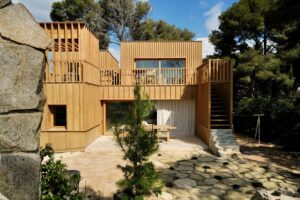
The project’s defining gesture is a lightweight timber superstructure that “wraps” the existing house like a hat. This prefabricated addition significantly improves spatial quality and thermal performance while preserving the original footprint. Timber plays multiple roles in the design: as structure, as a comfort regulator, and as a mediator between old and new architectural elements. The choice of timber also supports a dry construction process that minimizes disruption to the site and its neighbors.
This intervention results in a compact housing collective composed of three autonomous units. The ground floor remains a main family apartment, while above are two separate dwellings: a studio and an independent bedroom with bathroom. Instead of internal corridors, these units are linked by exterior stairs and terraces, fostering a sense of autonomy while maintaining proximity and visual connection among residents. This organization embodies a reversible, adaptable mode of habitation, allowing the collective to evolve with the family’s shifting needs.
Environmental considerations are integral to the project’s strategy. The site’s soil was de-sealed to restore permeability, counteracting the impermeability typical of suburban lots. Natural cross-ventilation ensures comfort within all units, reducing reliance on mechanical systems. Bio-based materials—primarily timber and local stone—are used extensively, and even façade offcuts have been repurposed to minimize waste. These measures reflect a holistic approach to sustainability that considers environmental impact from construction through occupation.
The intervention also offers a critique of post-war suburban development, which traditionally prioritized single-family homes and low density. By re-imagining an ordinary house as a small collective, the project proposes a gentle densification strategy that enriches existing fabric without resorting to large scale redevelopment. Instead of erasing the past, this proposal demonstrates how existing buildings can be reinforced, repaired, and reprogrammed to support more inclusive, sustainable living patterns.
In The Very Small Collective, AT Architecture presents an architectural solution that is modest in scale but rich in potential implications. It quietly asserts that thoughtful design can extend the life of existing structures while addressing pressing issues such as housing adaptability, environmental responsibility, and intergenerational living. Through careful material choices, spatial organization, and respect for heritage, the project stands as a replicable model for sustainable suburban transformation in contexts where incremental change rather than wholesale redevelopment is both necessary and desirable.
Project details:
-
Interior Designers: AT Architecture
- Area: 140 m²
- Year: 2024
-
Photographs:Agence AT
-
Lead Architects: Céline Teddé & Jérôme Apack Architects
-
Category: Houses, Renovation
-
Extension Area: 22 m²
-
Vertical Addition Area: 66 m²
-
City: Carry-le-Rouet
-
Country: France
Learn more: https://www.archdaily.com/1037576/the-very-small-collective-at-architecture