In 2018, NELMA challenged architecture and design students to imagine a lunar colony built with wood. At the time, it read like creative speculation — an exercise in rethinking a familiar material in an unfamiliar place. Seven years later, with astronauts having just looped around the Moon on the Artemis II mission and NASA actively planning permanent surface infrastructure as a waypoint to Mars, those student designs look less like imagination and more like early drafts.
The two winning entries from 2018 are worth revisiting.
 First-place winner Esther Medina, of California Polytechnic State University, designed a five-story lunar colony housing 56 people. Her Lunar Colony addressed the hard realities of off-planet living: a water recycling center capable of recovering 90 percent of daily water use, photovoltaic dome panels for power generation, and farms providing both food and oxygen for residents. One of those farms was a stand of poplar trees — which, after their 15-year productive lifespan, would yield lumber. The colony didn’t just use wood. It planned for it.
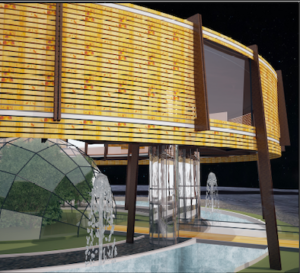
Second-place winner Timothy Oluwaseyi Uzoigwe, of the University of Illinois, took a different angle with his Lunar Workspace — a suspended, circular structure whose form drew from spacecraft aesthetics, hovering over a greenhouse, water pool, and outdoor park. His structural system was direct: an inverted U-shaped SPF laminated timber column carrying diamond-shaped beams formed from NELMA Finish Grade Eastern White Pine. Uzoigwe set his design near the Moon’s south pole, where near-constant sunlight makes solar energy viable. He also looked ahead: “It’s believed that wood has come a long way structurally as a material,” he wrote, imagining a 2035 in which exposed wood is “proudly displayed, adored and celebrated.”
That framing deserves a second look today. Both students independently identified the lunar south pole as their preferred site — the same region NASA is now targeting for its first crewed landing. Both designs treated water recycling and food production not as amenities but as structural necessities. Both incorporated wood not as a romantic gesture but as a rational material choice: renewable, growable on-site over time, and capable of performing structurally in ways that aluminum and composites cannot match for certain applications.
The Artemis program’s evolving architecture — now focused on building permanent surface infrastructure rather than an orbital waystation — puts a premium on exactly the kind of closed-loop, resource-efficient thinking these students brought to their designs. Long-duration habitation on the Moon, and eventually Mars, requires materials that can be grown, harvested, and replenished locally. That’s not a description of steel or carbon fiber. It’s a description of wood.
NELMA’s 2018 competition asked students to justify wood in the most demanding possible environment. The answers they gave — structural performance, sustainability, renewability, and the psychological value of natural material for people living far from Earth — hold up. The industry that produces eastern white pine and SPF lumber has been making those arguments for decades in more familiar contexts. It turns out the same case works on the Moon.
The competition is on hiatus, but may return. Either way, the question it posed — what can wood do that no other material can? — is more relevant now than when it was first asked.