Architectural Monographs: A New Beginning in Modern Times

White Pine Monographs Revitalization 1

In 2006, nearly seventy years after the last White Pine Architectural Monograph was published, NeLMA revived the series with Volume XXVII, Issue I, ‘A Historical Perspective And A New Beginning.’ The series that started in 1915 to promote the use of Eastern White Pine was an industry favorite during the 1920s and 1930s, gaining a readership around the country, is back with a fresh perspective, covering new ground.

Each issue of the White Pine Monographs has featured diverse topics relating to the architecture and construction industry in the United States, particularly the use of wood, with a special focus on Colonial buildings. A unique author, often an architect or architectural historian, wrote each introduction, and the issues included large photographs, sketches and blueprints.

White Pine Monograph Revival 3

The revival “takes a glimpse at the past while keeping a pulse on the future,” opening with ‘The King’s Broad Arrow: A treatise on early building with Eastern White Pine,’ and continuing with features on sheathing techniques and craftsmen inspired by the original White Pine Series of Architectural Monographs.

White Pine Monograph Revival 2

Also featured in this issue is the story of Limington Lumber, an Eastern White Pine lumber mill that has survived and thrived during the industry’s transitory phases over fifty years.

Read more at the White Pine Monograph Library.
Architectural Monographs: Forgotten Farmhouses on Manhattan Island

Forgotten NYC Farmhouses 1

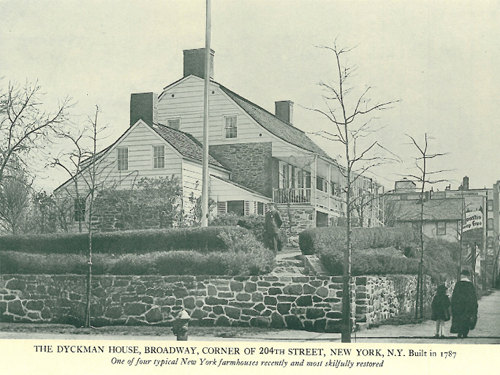
21st century Manhattan is one of the most thoroughly urban places in the world, its relatively small land area packed with an astonishing number of high-rise buildings. So, it’s easy to forget that farmhouses once stood on famous streets like Broadway. By 1923, when this volume of the historic White Pine Architectural Monographs was written, just a few Colonial houses remained in Greater New York, and there are even fewer today (two notable examples being Dyckman Farmhouse, now a museum, and the Edgar Allan Poe Cottage in The Bronx.)

Forgotten NYC Farmhouses 2

At the beginning of the 19th century, Greenwich Village, Chelsea, Bowery, Harlem, Murray Hill and other neighborhoods were just small individual settlements with a dozen or so farmhouses each, plus stores, churches, blacksmiths and doctors. It wasn’t until the 1880s that these farmhouses began to disappear. The author of this article reports that “enormous, ugly brownstone ‘flats’ were rearing their galvanized cornices in the air on every hand. The few scattered farm lots that remained seemed to be waiting in a sullen kind of way for the time when they too should be absorbed in the mad rush of flimsy, unsanitary Jerry-building.”

Forgotten NYC Farmhouses 4

In 1923, the last of Manhattan’s farmhouses were among the only wooden structures in the city. Some of these homes dated back to the mid-1700s. Many were left in a state of disrepair, so it’s not surprising that they were torn down without regard for historical preservation. Check out Volume IX, Issue I of the White Pine Monographs for details and photographs.

Forgotten NYC Farmhouses 6

Wrote Daniel Denton in 1670 of these homes, “Though their low-roofed houses may seem to shut their doors against pride and luxury, yet how do they stand wide open to let charity in and out, either to assist each other, or to relieve a stranger.”

Architectural Monographs: Competition for an Unusual Lakeside House

Monographs Vacation Season 1

In 1918, an owner of a lakeside lot in New York sought plans for the perfect vacation home, to be built for no more than $5,000 in a design that would blend in with a nearby village. The White Pine Series of Architectural Monographs sponsored a competition for plans that include a spacious living room, a grand fireplace, recreational space, a sleeping porch and a boat dock, inspiring dozens of architects to participate.

But the resulting entries, as noted in Volume IV, Issue IV of the Monographs entitled ‘Vacation Season,’ were largely disappointing because they ignored the call to design a house that isn’t in the typical cabin or lakeside bungalow style. Apparently, the architects got lost in daydreams about what they would like in their own vacation home on a lake, rather than addressing the needs of the homeowner (and can we blame them?)

Monographs Vacation Season 2

The jury’s description of the entries reflects what they call “an almost painful absence of direct, synthetic, logical thought.” Though several designs – which ultimately won first through fourth places – clearly stood apart, others had to be excluded “on account of a perhaps small but significant indication of a blind spot in the brain.” The first prize-winning entry is simple, direct and logical, but also beautiful, and artfully rendered.

Monographs Vacation Season 3

“It is rare that artistic skill of such a quality is combined with such practical good sense as is shown by the floor plans,” they write of the winner, Richard M. Powers. “Most of the practical solutions were painfully deficient in any sense of purely aesthetic values, while the ‘snappy’ drawings too often served only as cloaks for flagrant architectural sins.”

Monographs Vacation Season 4

Read more about the winning entries, and see more images, at the White Pine Architectural Monographs Library.

Architectural Monographs: The Bristol Renaissance of Rhode Island

Bristol Renaissance 1

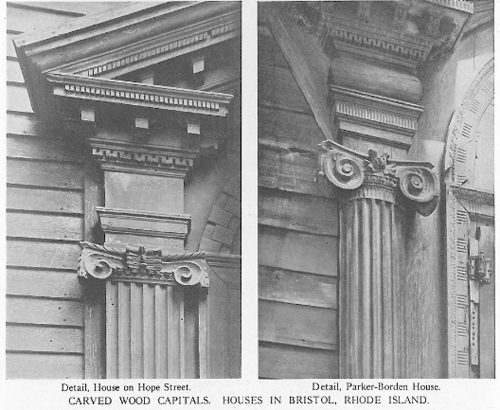
In a period of what was otherwise homogenous ‘Early Nineteenth Century Work’ in architecture, a particular cluster of homes and other structures stand out: those uniquely ornamented buildings constructed during the so-called Bristol Renaissance in Rhode Island. This architecture is not just notable for its carved details, ornamented parapet rails, elliptic stairways and intricate garden gates. It came about as a direct result of an influx of wealth from slave trading.

Bristol Renaissance 2

As we’re well aware today, these circumstances were not at all unusual, and the casual account of them written in Volume III, Issue V of the historic White Pine Architectural Monographs is an encapsulation of the views of the times. Author Joy Wheeler Dow writes, in 1917, “How does it affect us now, used as we are to the harrowing details of present-day war, to be told that out of this unholy traffic in flesh and blood grew many charming Bristol houses?”

Bristol Renaissance 3

“But let us not look upon an unavoidable circumstance too gloomily, nor yet uncharitably. Have you not come to believe that the man with the axe, standing before his rude cabin, vignetted on the five-dollar bills, has arrived at about as high a state of civilization and comfort as he can, unless, indeed, he goes in for a little genteel privateering and slave-trading – in gentler words, a little robbing of Peter to pay Paul?”

Bristol Renaissance 4

This issue shows details of the homes, explaining their architectural influences and how they differ from the more common building styles of the time. There’s also a special section on Eastern White Pine and how its price and availability was affected by the first World War. Give it a read at the White Pine Monograph Library.

The Pine Tree State: A History of Lumber in Maine

Maine Pine TreeThe towering Eastern White Pines of Maine, stretching up to two hundred feet into the sky, were an incredible sight for Europeans arriving for the first time in what would later become New England. Maine is now known as the Pine Tree State, and has taken the Eastern White Pine as its state tree (and even the White Pine Cone and Tassel as its flower, even though it’s not technically a flower.) This tree has played a major role in Maine history, from the very first days of colonization to the modern era.

Those tall trees were in such great demand, they played a role in sparking the Revolutionary War. Their trunks were ideal for use as masts in large seafaring vessels, and while Colonists depended on them to build their own ships and architecture, Great Britain began to claim the largest and strongest for its own ships. The conflict led to an incident known as ‘The Pine Tree Riot,’ one of the first real acts of rebellion against British rule.

Before it was settled, Maine was covered in forests, but colonists quickly began clearing large tracts of land for homes and farms, and to use the wood. The first sawmills of Maine were reportedly established in the early 1630s, and the lumber industry was in full swing by mid-century. By 1682, there were 24 sawmills operating in what is now Kittery, Wells and Portland.

By the 19th century, Bangor was the lumber capital of the world, home to over 300 sawmills. The Penobscot River played a large role in the industry, allowing loggers to send large logs from the northern Maine woods to Bangor, where they were processed. Today, the North Woods are a beautiful 10.4-million-acre undeveloped forest offering recreational opportunities for Mainers as well as visitors from all over the world.

It may seem, with all of this logging in the state’s history, that Maine would be in danger of exhausting its supply of trees. Yet today, almost 89% of the state is forested. In fact, it’s the most forested state in the nation. Timber continues to be a large part of the state’s economy, and Maine has been on the forefront of sustainable forestry.

Photos: Ohio State

Architectural Monographs: Design for a Roadside Tavern

EWP Monographs Roadside Tavern 1

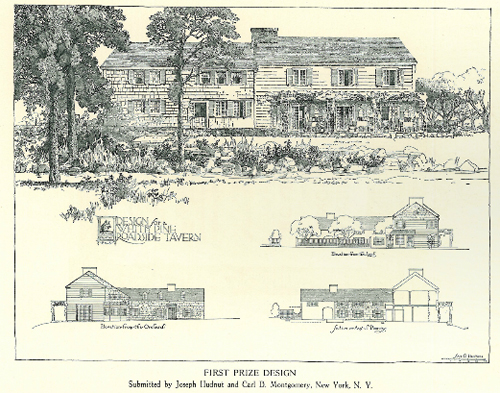
In 1920, the Fifth Annual Architectural Competition conducted by the White Pine Series of Architectural Monographs challenged architects to design a roadside tavern and its grounds, to be built of Eastern White Pine. The tavern was to include a restaurant and living quarters for the operators, with a 750-square-foot public dining room that could also serve as a dance floor in addition to a private dining room for men only.

EWP Monographs Roadside Tavern 2

One hundred designs were submitted in a variety of architectural styles, with the majority being “so good that they could not be readily or quickly eliminated,” a result that the Jury took as a sign of American architectural progress in general.

EWP Monographs Roadside Tavern 3

The first prize winner is an L-shaped design close to the road with parking in the back, making the most of a stream and apple orchard on the front of the site. “Simple and dignified, it is yet distinctly a tavern and not a private house, and the use of differing materials on the outside expresses very cleverly the main public parlors and the service wing.”

EWP Monographs Roadside Tavern 4

The second prize winner was right on this design’s coattails, with a plan that includes a hooded entrance and portico with sparing but effective wrought-iron details. Images of the plans for these two submissions as well as many more, and details about the competition, can be found in Volume VI, Issue IV of the White Pine Architectural Monographs.