Wood-Frame Emergency Shelters Made From Earthquake Rubble

emergency shelters 1

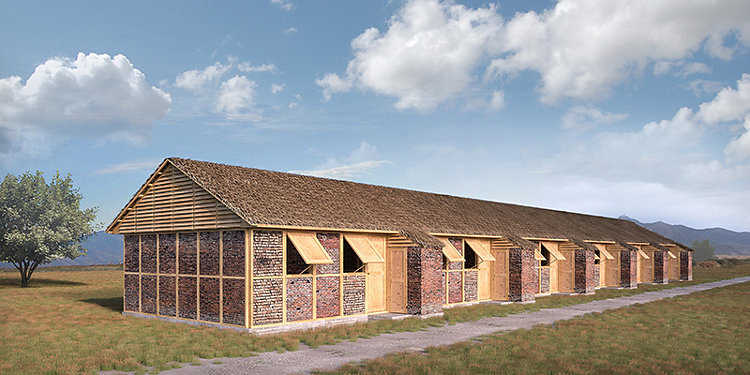
What’s the fastest way to erect quick, comfortable and durable emergency shelters while simultaneously clearing away rubble after an earthquake? Renowned Japanese architect Shigeru Ban, known for brilliant relief projects and ingenious use of paper products in architecture, has a solution so smart, it’s a wonder nobody thought of it already. This design is a modular shelter consisting of a wooden framework filled with brick rubble salvaged after a disaster.

emergency shelters 2 emergency shelters 4

Conceived after the 7.8-magnitude earthquake that devastated Nepal in April, these temporary relief shelters are low-cost and easy to assemble. Roof trusses are made from local paper tubes and sealed with plastic sheeting. Rubble is simply stacked within the wooden frames, which can be made with local materials and put together quickly.

emergency shelters 3

This particular project visually references Nepalese architecture, but the concept could be adapted for virtually any place in the world where lumber is readily available. The first small shelter based on this design is expected to be complete in Nepal by the end of August in collaboration with Ban’s humanitarian organization, Volunteer Architects Network (VAN).
Forest Facts: Over-Harvesting No Longer a Top Threat to Forests

maine forest

Ask the average person to identify the number one threat to forests in America, and they’ll probably say logging. In the past, over-harvesting was certainly a problem, as more trees were cut than could be replaced. But times have changed, and now that a large percentage of America’s forests are owned by families and individuals rather than timber companies, it’s actually suburbanization and converting forests to other non-forest uses that’s wiping out tracts of undeveloped woodland.

According to a new report called Vanishing Pieces of the Puzzle by the American Forest Foundation, 56 percent of the nearly 800 million wooded acres in the United States are in private hands, and two-thirds of those acres are owned by 22 million individuals. Those private owners are clearing their forests for suburban development and pastures, selling them to pay bills, and dividing them up into smaller parcels as each generation passes. Many privately-owned forests are also being devastated by wildfires and tree-killing insects and diseases.

Based on data from the U.S. Forest Service, the report goes into detail about how these threats are affecting ecosystems, water quality, and quality of life for people living in communities with diminishing forested lands. So, what can be done to save them? Make them more valuable to the owners by increasing markets for sustainable wood, for one thing.

“What most don’t realize is that harvesting can be a vital sustainable forestry practice, and helps restore and sustain important forests – like bottomland hardwoods,” says Tom Martin, AFF President and CEO. “Land owners who are active in the American Tree Farm System, harvest to keep their forests healthy, then sell to markets who want sustainable wood, which enables them to earn income to replant, restore and keep their forests as forests – protecting a vital carbon sink for all.”

Read the whole report here, or learn more about how sustainable forestry works.

Photo: Wikimedia Commons

This Week in Wood: World’s Tallest Wood Building Proposed for Paris

tallest wood building


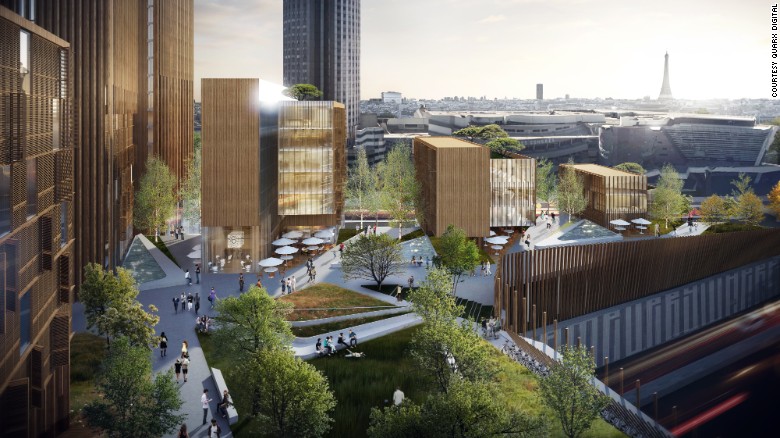
Is this sky-high structure the wooden equivalent to the Eiffel Tower? Proposed for Paris, the 35-story tower at the center of the Baobab complex will be the world’s tallest building made of wood if it ends up being built. In collaboration with French architectural partners DVVD and real estate group REI France, Canadian architecture firm MGA submitted the concept for a design competition called Reinventer Paris looking to revitalize architecture in one of the world’s poshest cities.

tallest wooden building 3

Known for his pioneering work in tall wooden structures, lead architect Michael Green envisions the sustainable structure as an environmentally friendly and creative way to approach the city’s housing challenges. The Baobab complex includes residences, a student hotel, a bus station, an e-car hub and park-like green spaces.

tallest wooden building 2

“We love the idea that a wood tower in Paris, however modest in some respects… will help champion a new global wave of building with more sustainable, renewable and beautiful materials,” Green told CNN.

The architects estimate that the wooden high-rise could sequester 3,700 metric tons of carbon emissions, equivalent to taking 2,207 cars off the roads for a year. MGA previously published a study called The Case for Tall Wood Buildings as a guide for other designers to look at the renewable material in a new way. Watch a video of Michael Green discussing the cultural perceptions of building with wood.


This Wooden Structure Has a Lower Carbon Footprint Than an iPhone 6

wooden structure 2

How can an architectural wooden structure that towers above the average person have a smaller carbon footprint than a gadget that fits into the palm of your hand? It’s all in the materials. An installation entitled ‘The Invisible Store of Happiness’ by designer Sebastian Cox and sculptor Laura Ellen Bacon stands as an example of the sustainability of wood, as well as its beauty and versatility, with ribbon-like sections of wood bent to create an intricate design within the structure’s core.

wooden structure 1

Standing beneath the 16th century arch of St. John’s Gate in London, the structure is made of steam-bent and twisted lengths of wood. Cox, who specializes in designing and building wooden furniture using traditional techniques, and Bacon, known for large site-specific sculptures made of woven and knotted wood, brought their complementary skills together to build a single structure. They got the idea after researching how much carbon is expended in the manufacture of Apple’s iPhone 6.

wooden structure 3

“We set ourselves the challenge of making the whole piece for less carbon than an iPhone 6,” Cox told Dezeen. “Every element in the making process was considered in the context of how it would affect the end figure of 100 kilograms of CO2.”

wooden structure 4

The structure ended up standing 9.2 feet tall, and acts as a metaphorical store of carbon, who recorded every kilogram of CO2 that was expended on the project during its manufacture and transport. Concentric layers of cherry and maple wood are set within the frame, attached by 380 clueless mortise and tenon joints. Each piece of wood was soaked in water overnight and then steamed at a very high temperature to make it pliable before being bent around formers and clamped in place as it cooled.


It’s a beautiful testament to the sustainability of wood, not to mention the lasting beauty and quality of time-honored wood joinery techniques.


Green Getaway: Relaxing Writing Retreat Made of Eastern White Pine

Screen shot 2015-01-14 at 3.04.38 PM

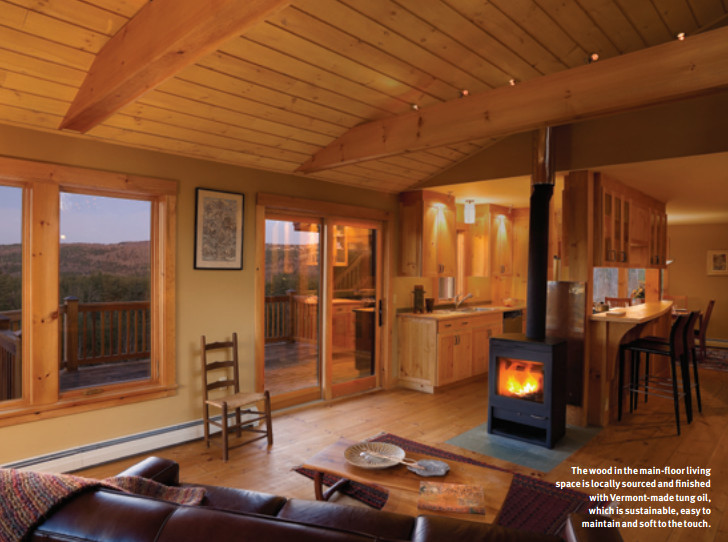
The warmth of Eastern White Pine gives the interior of this writing retreat in rural Vermont a cozy and welcoming feeling. Designed by architect Milford Cushman and built by Montpelier Construction, this three-level home is a green cottage crafted with sustainability in mind, the compact 16-by-40 footprint fitting neatly onto a steel hill on a small parcel of land.

Screen shot 2015-01-14 at 3.04.46 PM

sanctuary-04-lg

The vacation home was designed for a pair of academics and writers who wanted a custom-built retreat on a budget, maximizing warmth and light from the south despite the north-facing layout of the site. It features an open floe plan on the central level, lots of glass for looking out onto the landscape, and an entry-porch covered by a shed roof.

Screen shot 2015-01-14 at 3.04.58 PM

The builders chose Eastern White Pine for the floors, ceilings, cabinets and trim, leaving these surfaces minimally finished to let the wood’s natural beauty shine. Based in Vermont, Cushman Design Group frequently uses this local and eco-friendly material in their designs, including the beautiful barn-inspired Goose Farm residence.

White Water Village: Eastern White Pine Cottage in Ontario

whitewater 1

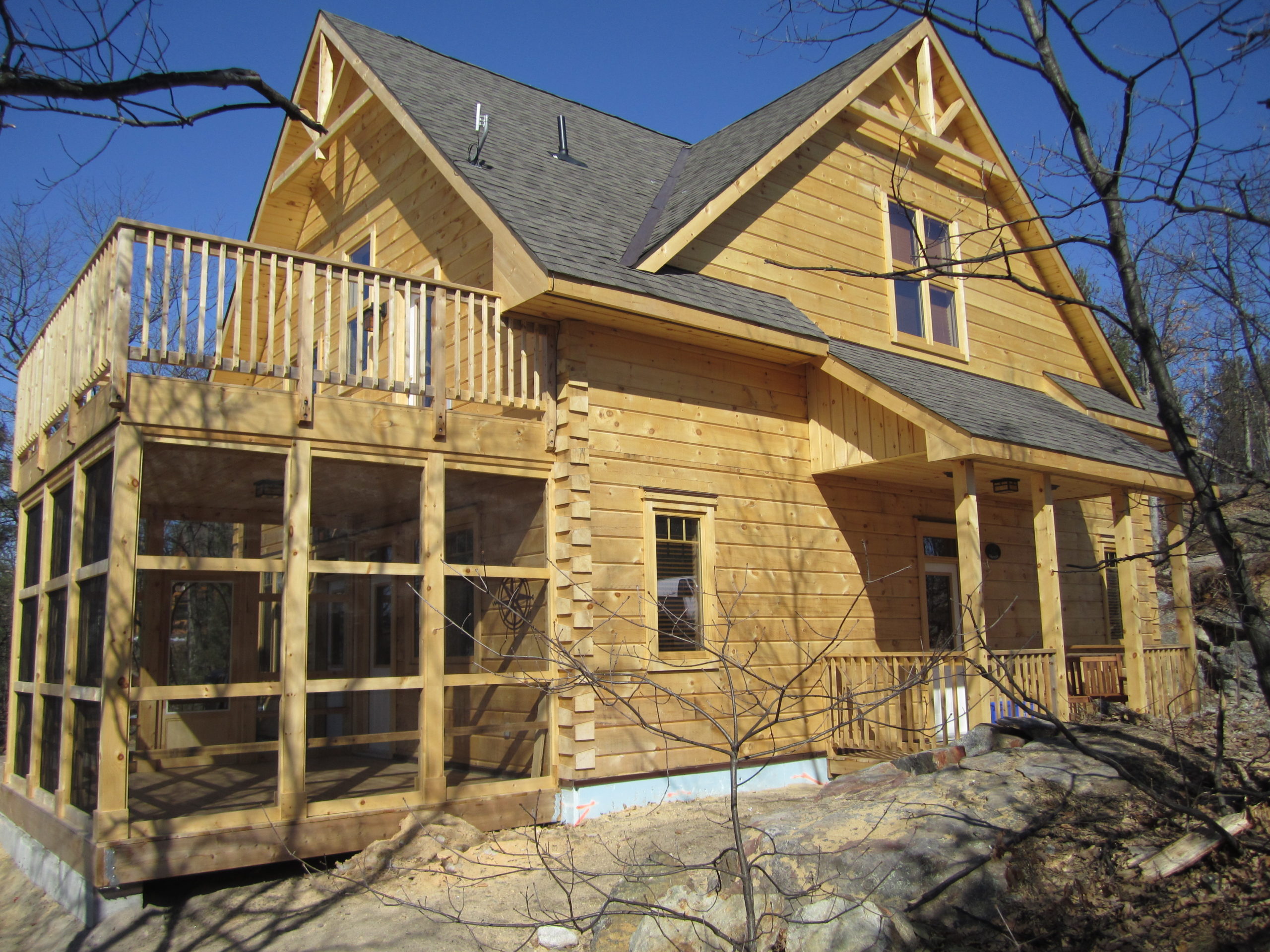
Eastern white pine was chosen as the primary material for a series of cottages at White Water Village, a sustainable, all-season community on the Ottawa River in Canada. Built by Kealey & Tackaberry Log Homes, the cottages feature timber dove-tail log construction and include a timber-framed screen room and an open deck.

whitewater 2

Kealey & Tackaberry is dedicated to creating homes that meet their clients’ needs, style and budget using materials that are sustainable and renewable. The company seeks out materials that are both environmentally responsible and authentic.

whitewater 4

Eastern white pine meets these requirements both in its standout beauty as long, large-circumference hand-peeled or hewn logs, and by being harvested at the end of its life cycle to ensure healthy forests. “In fact, our homes leave a small carbon footprint behind,” says K&T. “We believe, with each home produced, we actually help create a better world.”

whitewater 3

Learn more about the sustainability of Eastern White Pine.