Squam Lake: Award-Winning Eastern White Pine Timber Frame Home

Eastern White Pine Timber Frame Main

Located on the shores of Squam Lake in Moultonboro, New Hampshire, this residence is a beautiful example of a timber frame home built with Eastern White Pine. The home was designed by Samyn D’Elia Architects as a vacation retreat that could accommodate the homeowners, their children and grandchildren, and received an Excellence in Architecture Award from the NH American Institute of Architects.

Eastern White Pine Timber Frame 2

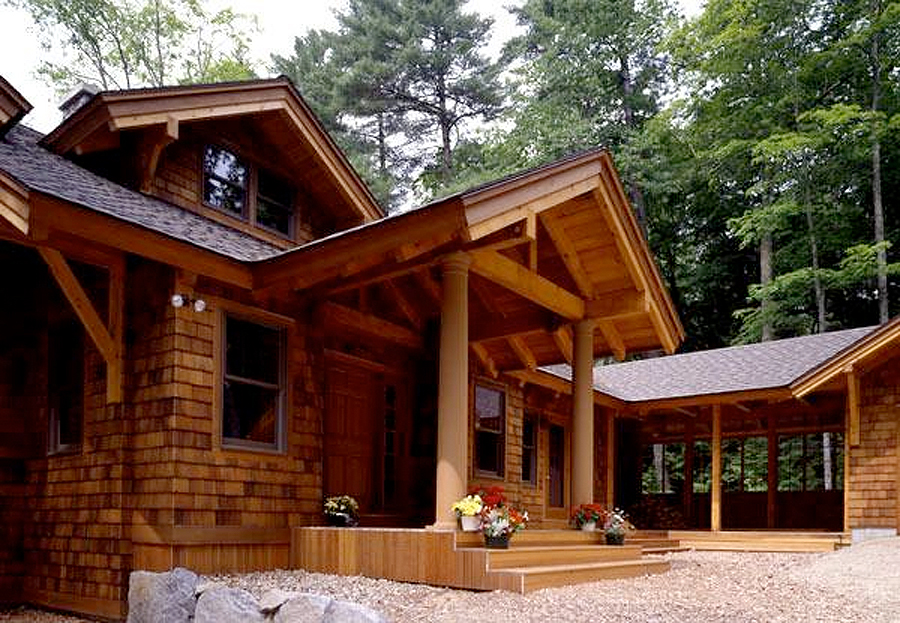
The home is set back from the lake with a series of boardwalks spanning the distance from the dock to the beach to protect sensitive wetlands. The exterior features red cedar shingles and wainscoting of locally hewn granite, and the interior shows off the eye-catching Eastern White Pine timber framing.

Eastern White Pine Timber Frame 3

Each of the upstairs suites provides private space for the owners’ adult children, and includes an adjacent sleeping porch. The grandchildren have their very own ‘Children’s Wing.’

Eastern White Pine Timber Frame 4

Eastern White Pine Timber Frame 5

Timber frame homes are making a big comeback, with a new report forecasting a 60% increase in sales volume and an 80% increase in value. More and more clients are requesting this rustic look for both year-round residences and vacation retreats. Eastern White Pine is a popular choice for timber frame homes for its aesthetic value, strength and affordability.

Architectural Monographs: Competition for an Unusual Lakeside House

Monographs Vacation Season 1

In 1918, an owner of a lakeside lot in New York sought plans for the perfect vacation home, to be built for no more than $5,000 in a design that would blend in with a nearby village. The White Pine Series of Architectural Monographs sponsored a competition for plans that include a spacious living room, a grand fireplace, recreational space, a sleeping porch and a boat dock, inspiring dozens of architects to participate.

But the resulting entries, as noted in Volume IV, Issue IV of the Monographs entitled ‘Vacation Season,’ were largely disappointing because they ignored the call to design a house that isn’t in the typical cabin or lakeside bungalow style. Apparently, the architects got lost in daydreams about what they would like in their own vacation home on a lake, rather than addressing the needs of the homeowner (and can we blame them?)

Monographs Vacation Season 2

The jury’s description of the entries reflects what they call “an almost painful absence of direct, synthetic, logical thought.” Though several designs – which ultimately won first through fourth places – clearly stood apart, others had to be excluded “on account of a perhaps small but significant indication of a blind spot in the brain.” The first prize-winning entry is simple, direct and logical, but also beautiful, and artfully rendered.

Monographs Vacation Season 3

“It is rare that artistic skill of such a quality is combined with such practical good sense as is shown by the floor plans,” they write of the winner, Richard M. Powers. “Most of the practical solutions were painfully deficient in any sense of purely aesthetic values, while the ‘snappy’ drawings too often served only as cloaks for flagrant architectural sins.”

Monographs Vacation Season 4

Read more about the winning entries, and see more images, at the White Pine Architectural Monographs Library.

Architectural Monographs: The Bristol Renaissance of Rhode Island

Bristol Renaissance 1

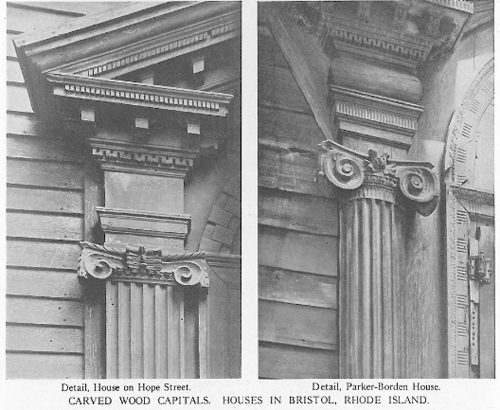
In a period of what was otherwise homogenous ‘Early Nineteenth Century Work’ in architecture, a particular cluster of homes and other structures stand out: those uniquely ornamented buildings constructed during the so-called Bristol Renaissance in Rhode Island. This architecture is not just notable for its carved details, ornamented parapet rails, elliptic stairways and intricate garden gates. It came about as a direct result of an influx of wealth from slave trading.

Bristol Renaissance 2

As we’re well aware today, these circumstances were not at all unusual, and the casual account of them written in Volume III, Issue V of the historic White Pine Architectural Monographs is an encapsulation of the views of the times. Author Joy Wheeler Dow writes, in 1917, “How does it affect us now, used as we are to the harrowing details of present-day war, to be told that out of this unholy traffic in flesh and blood grew many charming Bristol houses?”

Bristol Renaissance 3

“But let us not look upon an unavoidable circumstance too gloomily, nor yet uncharitably. Have you not come to believe that the man with the axe, standing before his rude cabin, vignetted on the five-dollar bills, has arrived at about as high a state of civilization and comfort as he can, unless, indeed, he goes in for a little genteel privateering and slave-trading – in gentler words, a little robbing of Peter to pay Paul?”

Bristol Renaissance 4

This issue shows details of the homes, explaining their architectural influences and how they differ from the more common building styles of the time. There’s also a special section on Eastern White Pine and how its price and availability was affected by the first World War. Give it a read at the White Pine Monograph Library.

Hand-Hewn Eastern White Pine ‘Jupiter Barn’ by Vermont Timber Works

Vermont Timber Works Jupiter Barn Main

With a frame cut from native Eastern White Pine and hewn by hand with an adze and slick, the Jupiter Barn house in Hunter, New York by Vermont Timber Works is a beautiful example of handcrafted traditional architecture made of a sustainable material. This home features a gambrel-style frame, traditional wood joinery, a wrap-around porch on the lower level and a balcony.

Vermont Timber Works Jupiter Barn 2

Vermont Timber Works Jupiter Barn 3

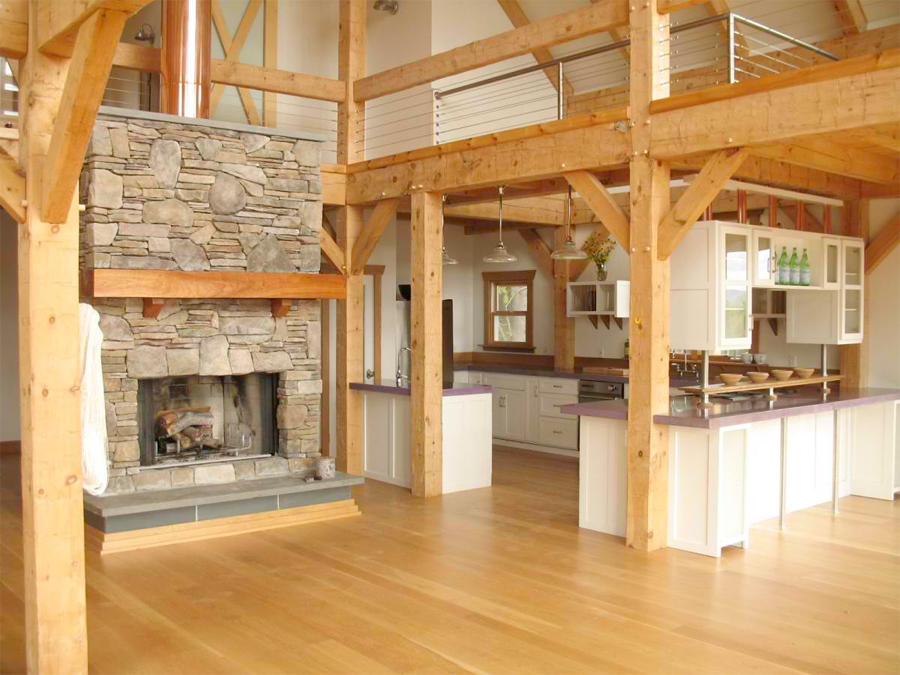
The post and beam frame not only provides the basic structure for this standout home, it’s also a main architectural feature of the interior. The rustic, rough finish of the wood provides striking visual flair, especially in contrast to the smoother finishes of drywall and contemporary-style wood flooring.

Vermont Timber Works Jupiter Barn 4

Vrmont Timber Works Jupitr Barn 5

Vermont Timber Works chose Eastern White Pine not only because it’s a material that grows locally, and is therefore economical and environmentally friendly to procure, but also because of its stability. White Pine is a popular choice for residential timber frames, because it’s less expensive than alternatives like Douglas Fir.

Vermont Timber Works Jupiter Barn 7

Jupiter Barn is just one of many striking hand-crafted structures with traditional framing styles produced by Vermont Timber Works. The company, based in North Springfield, provides lots of details about the whole building process (accompanied by plenty of photos) on their website, VermontTimberWorks.com.

Mountain Log Homes Show Off the Natural Beauty of Eastern White Pine

EWP Grandfather Mountain Log Cabins 1

The natural beauty of Eastern White Pine lumber is put on spectacular display in beautiful cabins by Grandfather Mountain Log Homes in North Carolina. In addition to authentic log cabins made of reclaimed wood, the company builds traditional-style log cabins in a variety of designs ranging from rustic, single-story structures in the style of Appalachian pioneer cabins to larger, more contemporary homes.

EWP Grandfather Mountain Log Homes 2

Each of the lofted cabins features exposed beams that create both the first floor ceiling and the second story floor. Exposed beams are also used to create cathedral ceilings that open up the space and make it feel airy and cozy at the same time. Each log cabin includes a “heavy timber” porch system including exposed rafter beams.

EWP Grandfather Mountain Log Homes 3

“Grandfather Mountain Log Home Packages contain solid Eastern White Pine logs that are inspected to the highest standards in in the industry today,” the company states. The photo gallery of cabin interiors demonstrates how the warmth and charm of this material can transform a space, whether in a country kitchen or a grand living room with a vaulted ceiling and stone fireplace.

EWP Grandfather Mountain Log Homes 4

Eastern White Pine is a popular choice for timber frame buildings, which are experiencing a boom in popularity, because of its affordability, reliability and aesthetic value.

Timber in the City: Design Contest Encourages Sky-High Wood Structures

EWP Timber in the City Contest

Another design contest promoting wood for urban projects could lead to even more large-scale wood architecture in the United States. Timber in the City encourages students and recent graduates to consider wood, a renewable resource, as a main material for tall structures. In addition to being affordable and sustainable, wood helps to provide healthy living and working environments.

The competition is organized by the Binational Softwood Lumber Council (BSLC), Parsons The New School for Design, and the Association of Collegiate Schools of Architecture (ACSA). BSLC executive director Cees de Jager notes that even though U.S. building codes allow wood-framed structures to reach five stories, it’s used in only 12 to 15 percent of mid-rise construction.

Contest entrances will design a mid-rise, mixed-use complex of affordable housing units made primarily of wood for Red Hook, a neighborhood in Brooklyn, New York. Winning teams will get cash prizes of $30,000. De Jager hopes that the contest will result in more architects initiating taller wood-built structures, and that wood buildings as tall as 16 to 20 stories will someday be possible in the United States.

This contest comes after architect Michael Green initiated a revolution in wood construction, unveiling a concept for a 30-story tower in Vancouver. Green’s project is made from laminated strand lumber. The architect has made his plans and an instruction manual on wooden skyscrapers available to other designers in order to spur on rapid innovation.