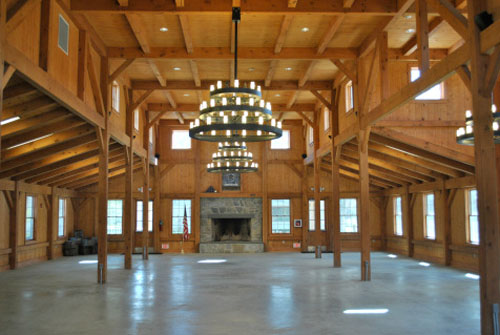
Eastern White Pine Timbers at the Deer Lake Scout Camp, Vermont

Deer Lake Timber Frame 1

Strong, economical and full of character, Eastern White Pine is a popular choice for traditional timber frame architecture, a style that’s experiencing a renaissance as interest grows in both sustainability and the charm of wood. This example highlights some beautiful, towering Eastern White Pine timbers in the Deer Lake Scout Camp in Vermont.

Deer Lake Timber Frame 2

Vermont Timber Works collaborated with Bismark Construction and Huestis Tucker Architects, LLC to create this vast timber-framed hall complete with a large stone fireplace and a striking rustic chandelier.

Deer Lake Timber Frame 3

Eastern White Pine structures like this one are especially common in the Northeast, where the trees grow in abundance. Architecture firms, designers and builders with an eye on sustainability like Eastern White Pine not only because it’s local and thus less expensive and carbon-intensive to ship, but also for its beauty, and the way that it’s grown.

Deer Lake Timber Frame 4

Planning for a healthy continued harvest into the future and keeping the local ecosystem in balance are among the benefits of the natural mixed forests in which Eastern White Pine is grown. Learn more about why Eastern White Pine is a green choice in wood building projects.

White Pine Architectural Monographs: Colonial Houses of Providence

Providence Monographs 1

The colonial architecture of Providence, Rhode Island, may not be as renowned as that of Salem or Portsmouth, but it’s just as historically important, with seaside dwellings dating to the beginning of the eighteenth century. Written in 1918, Volume IV, Issue III of the historic White Pine Architectural Monographs highlights some of the most important structures that survived into the twentieth century.

Providence Monographs 2

One example is the Christopher Arnold House, built about 1735, which features the oldest doorway in Providence with carvings that were likely inspired by those on even older furniture. Likewise, the Crawford House has “a very remarkable door with large, bent-over leaves above the caps of its pilasters, and the curious bending up of the back band in the middle of the lintel… doors like this are rare.”

Providence Monographs 3

“The second quarter of the century, especially the years just before 1750, and, of course, even more the years just before the Revolution, when the money from privateering in the Old French War was flowing into the town, saw the rise and spread here, as in the rest of New England, of the central-entry type of plan – that in which a long hall runs through the back, with two rooms on each side.”

Providence Monographs 4

“Most of the houses of this kind in Providence are of brick; thew olden house of early date on that plan is not common. At any rate, it has not survived in any numbers. It is to be seen it its glory for Rhode Island, in Newport and not in Providence.” Moving into the nineteenth century, after a period of construction inactivity during the Revolution, three-storied wooden mansions began to spring up. Read more at the White Pine Monograph Library.

Wavy-Edge Eastern White Pine Siding Adds Rustic Charm to Lakeside Home

Wavy Edge Siding Home 500

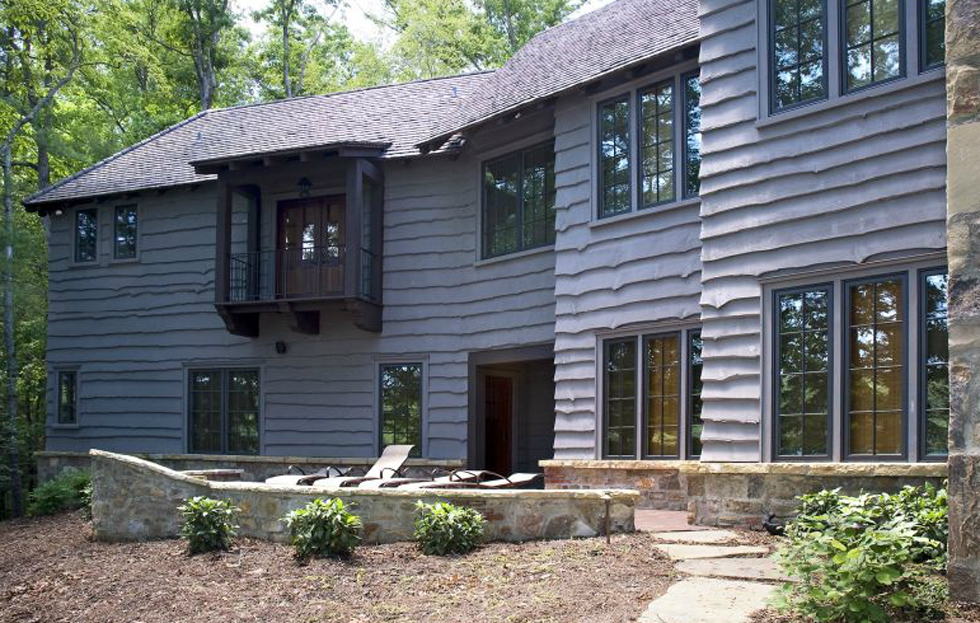
Wavy-edge siding has a bit more visual flair than standard siding, lending a rustic, hand-finished look with lots of charm. This type of siding leaves a bit of the wood’s natural character intact, cut at an angle along the log edge of the board. While it would be wholly expected on a rustic hunting cabin, it offers even more impact on a larger, more luxurious home, like this one on Lake Keowee in South Carolina.

Wavy Edge Siding Home 2

Located at the foothills of the Blue Ridge Mountains, The Cliffs at Keowee Vineyards is a luxury development filled with individually designed homes, each tailored to the individual needs and tastes of the owners but also reflecting the woodsy lakeside aesthetic.

Wavy Edge Siding Home 3

This particular home, designed by Summerour Architects, features wavy-edged Eastern White Pine siding finished in Manchester tan to blend in with the natural surroundings. Accents of stone and brick, and lots of rich wooden details throughout the interior, enhance the cozy feel.

Wavy Edge Siding Home 4

Virtually any mill or retailer offering Eastern White Pine lumber products can provide wavy-edged siding. Locate a lumber retailer at Nelma.org.

Architectural Monographs: Greek Revival in Owego, New York

Monographs Greek Revival 1

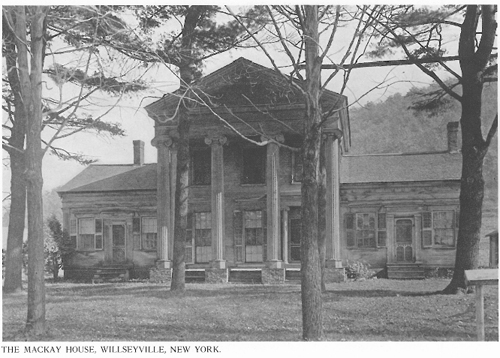
An architect who was not exactly the biggest fan of the Greek Revival style was sent by the editor of the Architectural Monographs to write a piece on such homes in New York, finding them to have, at least a little bit, an unexpected charm. Author Alexander B. Trowbridge jokes that perhaps seeing such a house was what led to the temperance movement, as a group of drinkers saw ‘certain queer shapes frisking on the roof just above the eaves.’ He writes, “The experience sobered them and the temperance society followed.”

Monographs Greek REvival 2

“Why the citizens of this section of our country chose pseudo-Greek architecture translated rather unintelligently into wood is a secret that disappeared with the whiskers. It is clear, however, that the finest homes of that period indicated an approval of the Greek revival by the best families. Why does the average educated architect dismiss the Greek Revival with a shrug? Is it not because he notes that the translation from the stone architecture of classic days to a white pine treatment was merely badly done?”

Monographs Greek Revival 3

Trowbridge argues that the giant wooden porticoes and pediments in wood are out of scale, and clumsy at times. But from the houses built in this style, something could be learned. Using the Greek style as inspiration, rather than imitating it, is the only way to incorporate such bold and ornamental details into Colonial American architecture, he says.

Monographs Greek Revival 4

Read more at the White Pine Library of Architectural Monographs.

Architectural Monographs: Early Wooden Architecture of Massachusetts

Monographs Early Wooden Architecture 1

Since they were founded in 1646, the towns of Andover and North Andover in Essex County, Massachusetts have served as an example of typical New England tradition and civilization, and that includes their architecture. These towns may have changed, like the rest of America, since this issue of the White Pine Architectural Monographs was written in 1917, but many of the homes featured here as illustrations of early wooden architecture still stand.

Monographs Early Wooden Architecture 2

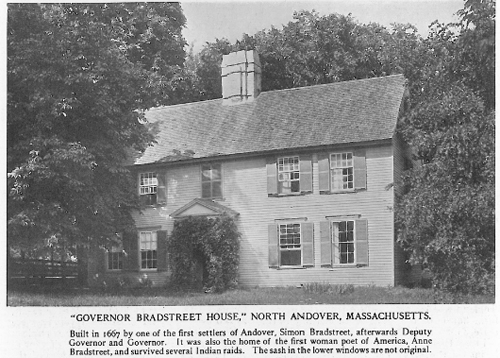
Of particular note is Andover Hill, where a group of about fifty houses sprung up after the establishment of the Phillips Academy  in 1778. The author of this monograph, Addison B. LeBoutillier, notes that the occupants of these houses “left names well known in history, literature and theology.” Among notable early Andover residents are New England’s first published poet, Anne Bradstreet, and her husband, Massachusetts Governor Simon Bradstreet. When this monograph was written, the house labeled ‘Governor Bradstreet House’ was believed to have truly been that of the Bradstreets, built in 1667, but historians have since realized that it was misidentified. It’s now known as the Parson Barnard House, believed to have been built in 1715.

Monographs Early Wooden Architecture 4

Other interesting wooden buildings in Andover and what is now West Andover include a number of gambrel houses, and spacious three-story houses “of a courtly period when the aristocratic ideas of old-country traditions still held in the style of living and social customs of the Colonies.”

Monographs Early Wooden Architecture 3

Learn more about the history of America’s earliest architecture in Volume III, Issue II of the historic White Pine Architectural Monographs.

Heavy Timber Eastern White Pine at the Southeastern Vermont Welcome Center

Southern Vermont Welcome Center White Pine main

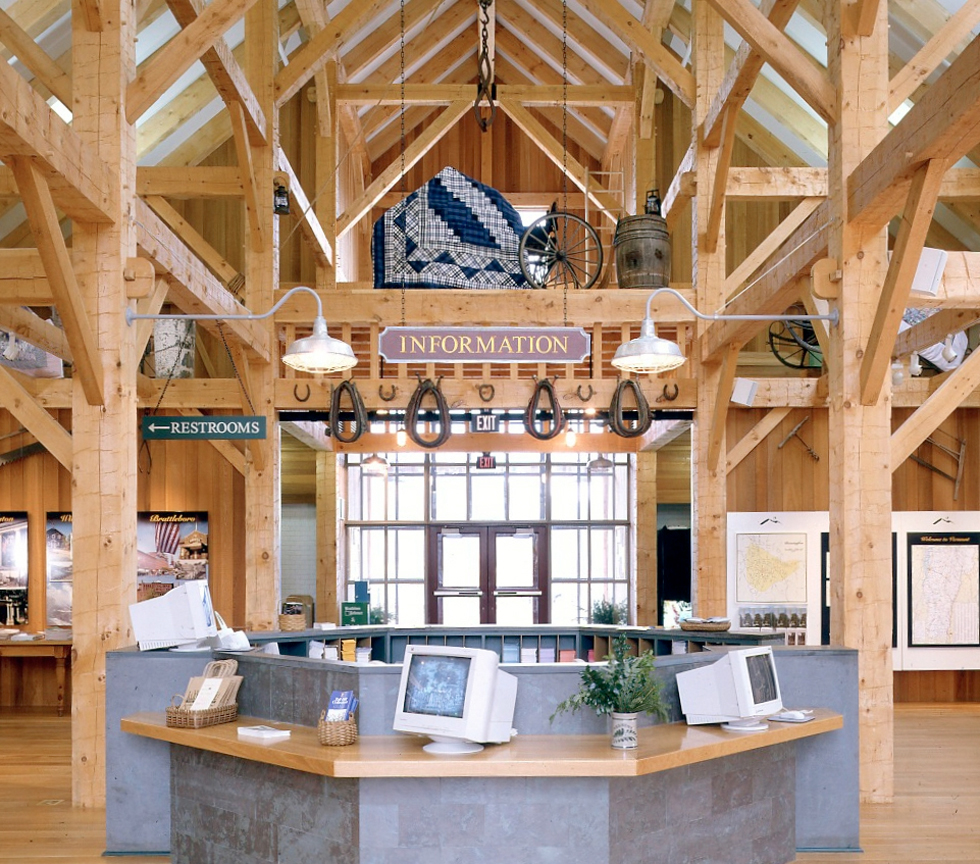
All of the dramatic beauty of heavy timber construction using Eastern White Pine is on display at the Southeastern Vermont Welcome Center, along with all of the exhibits featuring the state’s history. Designed and constructed by Vermont Timber Works, this beautiful commercial building stuns with an open framework of hand-hewn white pine timbers finished and joined the traditional way. Click each picture to get a look at the beauty of these timbers up close.

Southeastern Vermont Welcome Center White Pine 2

While many other construction methods typically hide the frame of a building, enclosing it within walls and ceilings, timber frame construction makes it an integral visual part of the finished structure.

Southeastern Vermont Welcome Center White Pine 3

Southeastern Vermont Welcome Center White Pine 4

Vermont Timber Works believes that working the timber by hand, with manual tools, produces a higher-quality result with more character than using automated machinery. They use razor-sharp chisels to shape the custom joinery.

Southeastern Vermont Welcome Center White Pine 5

That doesn’t mean they don’t use any modern tools at all: sophisticated design software and precision mortising machines, along with drill stands, band saws and beam saws enable them to create building components that fit together perfectly for incredibly strong, durable structures. See more at the Vermont Timber Works website.